FITC-Labeled Human MSLN/Mesothelin Protein
Catalog No: MSLN-HP001
- Species
- Human
- Expression System
- HEK293
- Tag
- His, Avi
Product overview
Recombinant FITC-Labeled Human MSLN/Mesothelin Protein is expressed in HEK293 cells with a His tag and Avi tag at the C-terminus. It contains amino acid residues Glu296-Gly580 (UniProt accession: Q13421-2).
Product Details
- Molecular Aliases
- MSLN; CAK1; Mesothelin; MPF; MPFSMRP; SMR
- Protein Length
- Glu296-Gly580
- Expression System
- HEK293
- Theoretical Molecular Weight
- The protein has a predicted MW of 35.2 kDa. Due to glycosylation, the protein migrates to 40-50 kDa based on Bis-Tris PAGE result.
- Purity
- > 95% as determined by Bis-Tris PAGE > 95% as determined by HPLC
- Buffer / Formulation
- Supplied as 0.22μm filtered solution in PBS (pH 7.4).
- State
- Liquid
- Storage Conditions
- Valid for 6 months from date of receipt when stored at -80°C. Recommend to aliquot the protein into smaller quantities for optimal storage. Please minimize freeze-thaw cycles.
Data Display
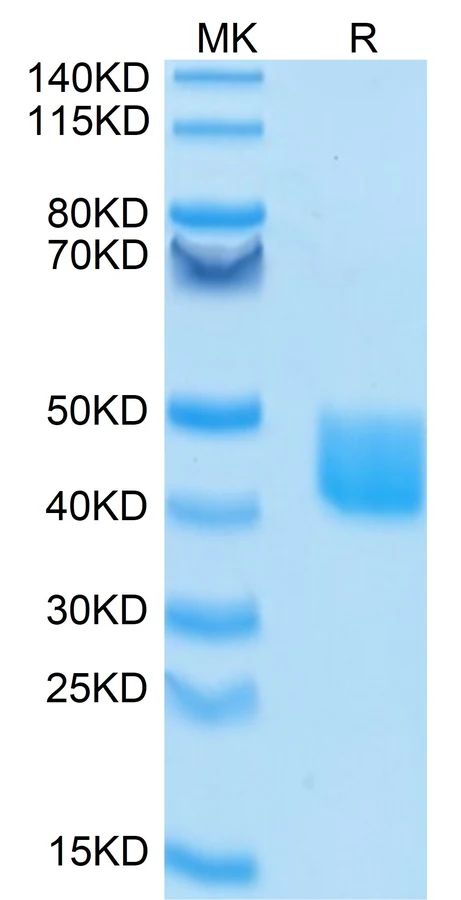
FITC-Labeled Human MSLN on Bis-Tris PAGE under reduced condition. The purity is greater than 95%.
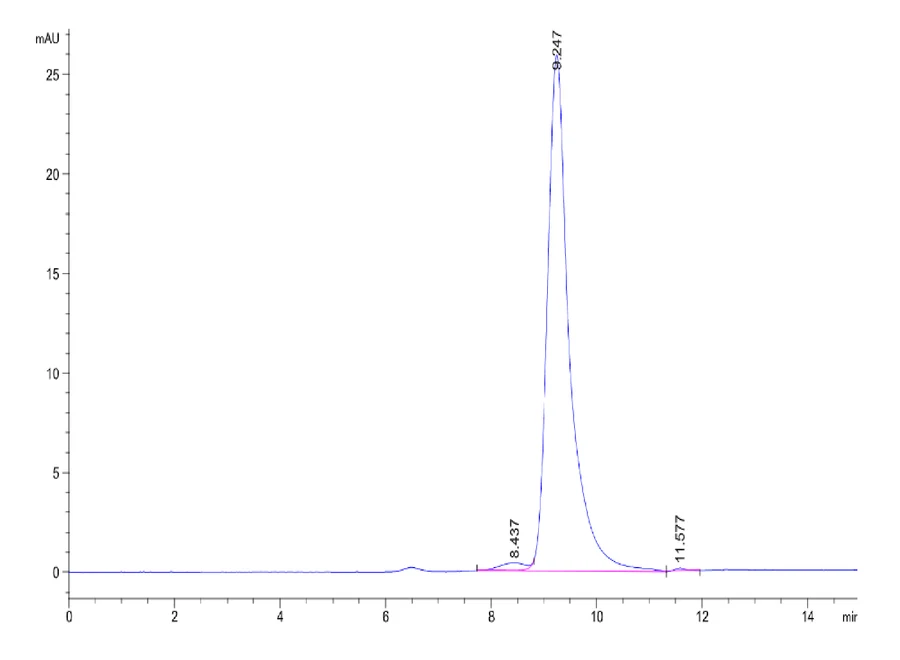
The purity of FITC-Labeled Human MSLN is greater than 95% as determined by SEC-HPLC.
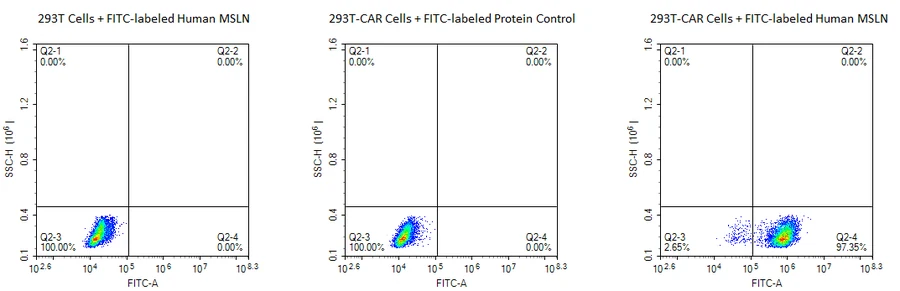
FACS Analysis of Anti-MSLN CAR Expression. 293T cells were transfected with anti-MSLN-scFv and His tag. Cells were stained with 5μg/ml FITC-Labeled Human MSLN (296-580), His Tag and FITC-labeled protein control. Non-transfected 293T cells and FITC-labeled protein control were used as negative control.
Background
Mesothelin, also known as MSLN, is a protein that in humans is encoded by the MSLN gene.Cloning studies showed that the mesothelin gene encodes a precursor protein that is processed to yield mesothelin which is attached to the cell membrane by a glycophosphatidylinositol linkage and a 31-kDa shed fragment named megakaryocyte-potentiating factor (MPF). Although it has been proposed that mesothelin may be involved in cell adhesion, its biological function is not known.A knockout mouse line that lacks mesothelin reproduces and develops normally.
References
- Adusumilli P S, Cherkassky L, Villena-Vargas J, et al. Regional delivery of mesothelin-targeted CAR T cell therapy generates potent and long-lasting CD4-dependent tumor immunity[J]. Science Translational Medicine, 2014, 6(261):261ra151-261ra151.
- Morello A, Sadelain M, Adusumilli P S. Mesothelin-Targeted CARs: Driving T cells to Solid Tumors[J]. Cancer Discovery, 2015, 6(2).
Have questions about this product?
Our technical team can help with product selection, application questions and order support.