Biotinylated Human NY-ESO-1 TCR&CD3 Complex VLP
Catalog No: NYESO1-HB001
- Species
- Human
- Expression System
- HEK293
- Tag
- Biotin
- Activity
- Activity verified
Product overview
Recombinant Biotinylated Human NY-ESO-1 TCR&CD3 Complex VLP is expressed from HEK293. It contains NY-ESO-1 specific TCR (1G4c113), CD3ε&CD3γ, CD3ε&CD3δ, and CD3ζ dimers
Product Details
- Molecular Aliases
- NY-ESO-1 TCR&CD3
- Expression System
- HEK293
- Purity
- > 95% as determined by HPLC
- Endotoxin
- Less than 1 EU per μg by the LAL method.
- Buffer / Formulation
- Supplied as 0.22 μm filtered solution in PBS, 300mM L-arginine (pH 7.4).
- State
- Liquid
- Storage Conditions
- Valid for 12 months from date of receipt when stored at -80°C. Recommend to aliquot the protein into smaller quantities for optimal storage. Please minimize freeze-thaw cycles.
Data Display
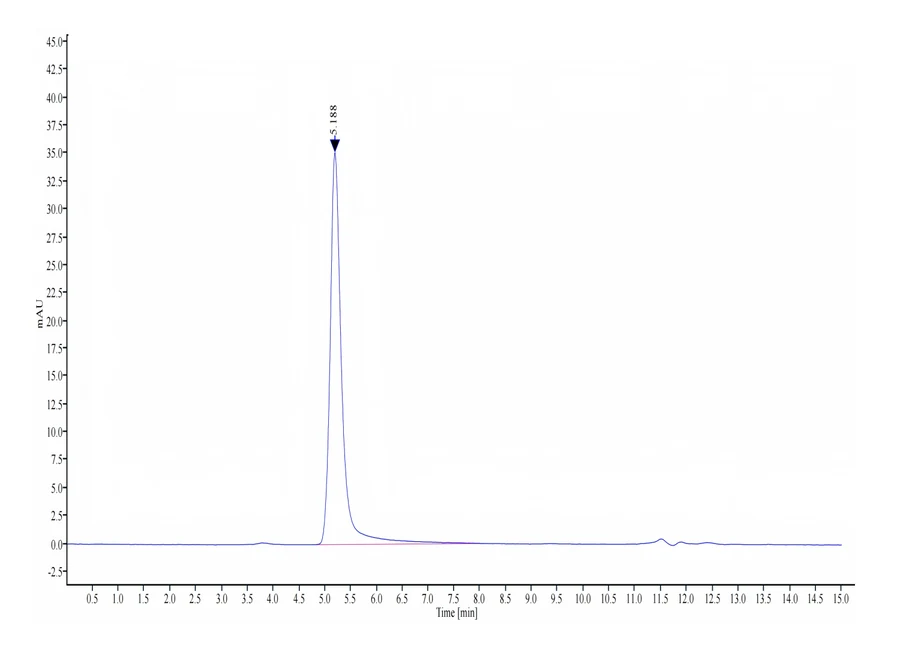
The purity of Biotinylated Human NY-ESO-1 TCR&CD3 Complex VLP is greater than 95% as determined by SEC-HPLC.
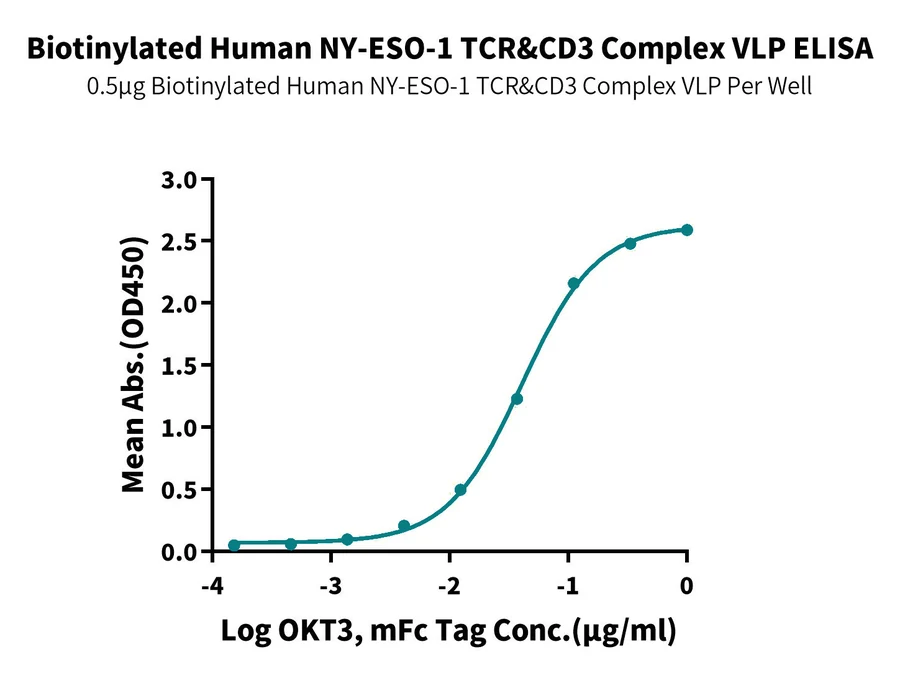
Immobilized Biotinylated Human NY-ESO-1 TCR&CD3 Complex VLP at 5μg/mL (100μl/well) on the streptavidin precoated plate (5μg/ml). Dose response curve for OKT3, mFc Tag with the EC50 of 40.6ng/ml determined by ELISA. (QC Test)
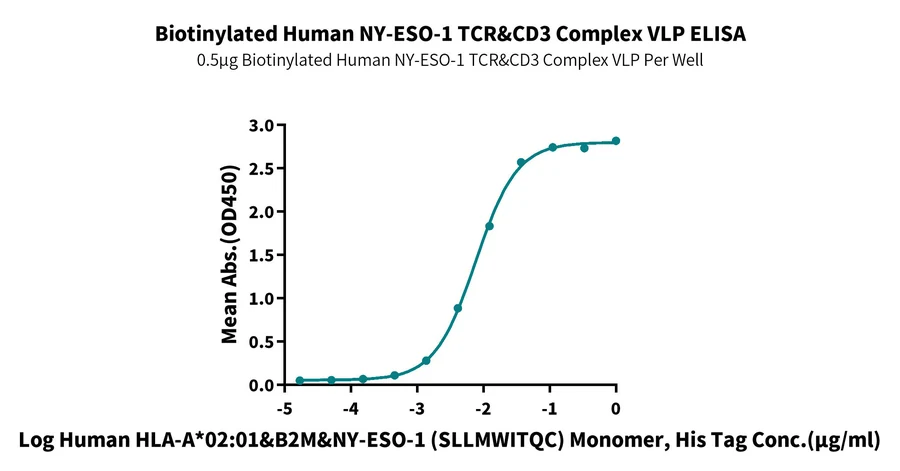
Immobilized Biotinylated Human NY-ESO-1 TCR&CD3 Complex VLP at 5μg/mL (100μl/well) on the streptavidin precoated plate (5μg/ml). Dose response curve for Human HLA-A*02:01&B2M&NY-ESO-1 (SLLMWITQC) Monomer, His Tag with the EC50 of 7.7ng/ml determined by ELISA.
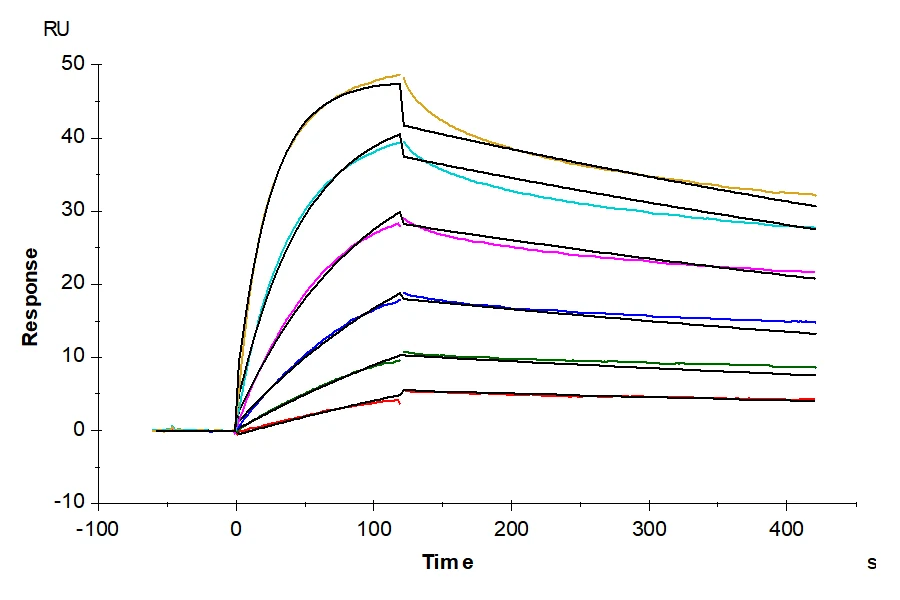
Biotinylated Human NY-ESO-1 TCR&CD3 Complex VLP captured on CM5 Chip via Streptavidin can bind OKT3, mFc Tag with an affinity constant of 0.13 nM as determined in SPR assay (Biacore T200).
Background
The 1G4c113 TCR is an engineered, affinity-matured variant of the 1G4 T-cell receptor that specifically recognizes the peptide fragment of NY-ESO-1 (SLLMWITQC) presented on the HLA-A*02:01. Cluster of Differentiation 3 (CD3) is a multimeric protein complex and T cell co-receptor that plays an essential role in adaptive immune responses. These CD3 dimers bind non-covalently to the TCR to form the TCR&CD3 complex on the cell surface.
References
- (1) Zhao, Yangbing, et al. "High-affinity TCRs generated by phage display provide CD4+ T cells with the ability to recognize and kill tumor cell lines." The Journal of Immunology 179.9 (2007): 5845-5854. DOI: 10.4049/jimmunol.179.9.5845 PMCID: PMC2140228, PMID: 17947658 (2) Li, Yi, et al. "Directed evolution of human T-cell receptors with picomolar affinities by phage display." Nature biotechnology 23.3 (2005): 349-354. DOI: 10.1038/nbt1070, PMID: 15723046
Have questions about this product?
Our technical team can help with product selection, application questions and order support.