Human CXCL13/BCA-1 Protein
Catalog No: CXCL13-HF001
- Species
- Human
- Expression System
- HEK293
- Tag
- an hFc (IgG1)
- Activity
- Activity verified
Product overview
Recombinant Human CXCL13/BCA-1 Protein is expressed in HEK293 cells with an hFc (IgG1) tag at the N-terminus. It contains amino acid residues Val23-Per109 (UniProt accession: O43927).
Product Details
- Molecular Aliases
- ANGIE; ANGIE2; BCA-1; BCA1; BLC; BLR1L; SCYB13
- Expression System
- HEK293
- Theoretical Molecular Weight
- The protein has a predicted MW of 37.6 kDa. Due to glycosylation, the protein migrates to 42-50 kDa based on Bis-Tris PAGE result.
- Purity
- > 95% as determined by Bis-Tris PAGE > 95% as determined by HPLC
- Endotoxin
- Less than 1 EU per μg by the LAL method.
- Buffer / Formulation
- Lyophilized from 0.22 μm filtered solution in PBS (pH 7.4). Normally 8% trehalose is added as protectant before lyophilization.
- State
- Lyophilized
- Storage Conditions
- -20 to -80°C for 12 months as supplied from date of receipt. -80°C for 3 months after reconstitution. Recommend to aliquot the protein into smaller quantities for optimal storage. Please minimize freeze-thaw cycles.
- Reconstitution Advice
- Dissolve the lyophilized protein in distilled water. Please refer to the Certificate of Analysis for detailed instructions.
Data Display
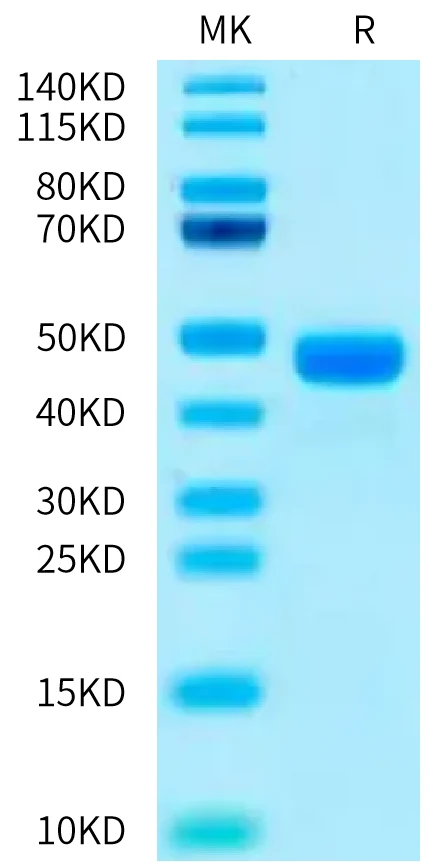
Human CXCL13 on Bis-Tris PAGE under reduced condition. The purity is greater than 95%.
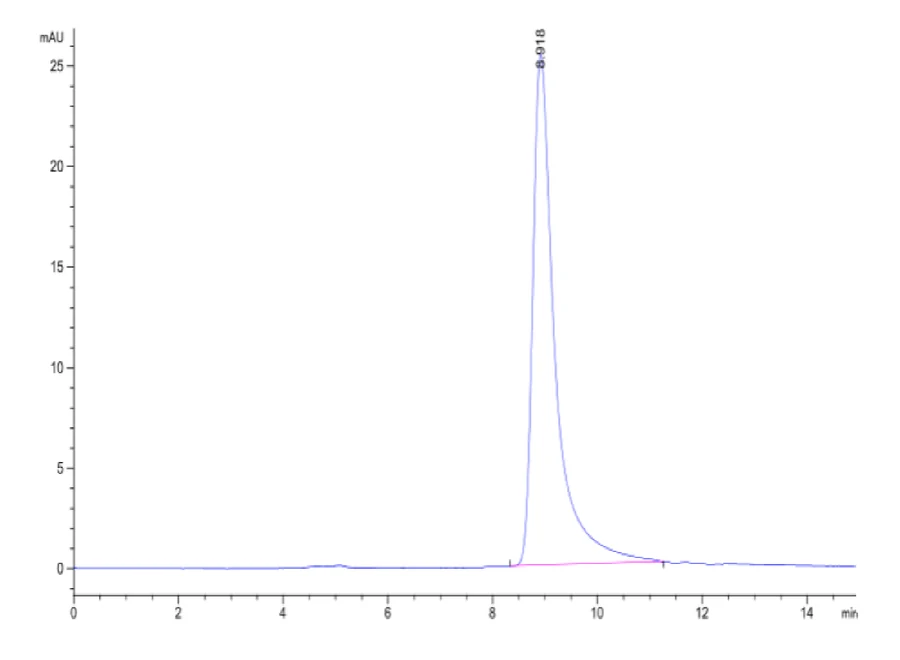
The purity of Human CXCL13/BCA-1 Protein is greater than 95% as determined by SEC-HPLC.
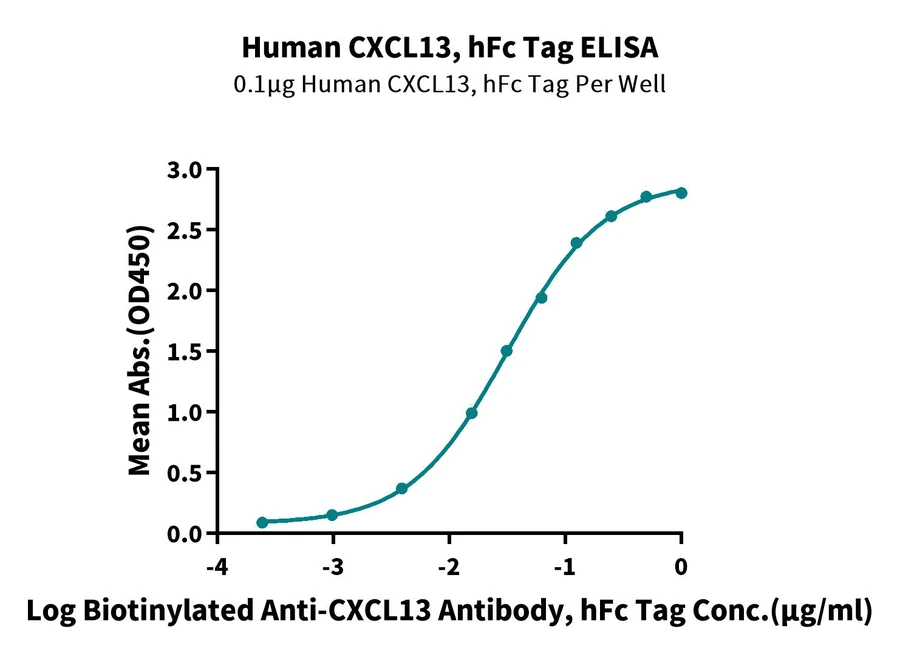
Immobilized Human CXCL13, hFc Tag at 1μg/ml (100μl/well) on the plate. Dose response curve for Biotinylated Anti-CXCL13 Antibody, hFc Tag with the EC50 of 31.3ng/ml determined by ELISA (QC Test).
Background
Recent studies have implicated chemokines in microglial activation and pathogenesis of neuropathic pain. C-X-C motif chemokine 13 (CXCL13) is a B lymphocyte chemoattractant that activates CXCR5. Using the spinal nerve ligation (SNL) model of neuropathic pain, CXCL13 was persistently upregulated in spinal cord neurons after SNL, resulting in spinal astrocyte activation via CXCR5 in mice.
References
- Jiang BC, Cao DL, Zhang X, Zhang ZJ, He LN, Li CH, Zhang WW, Wu XB, Berta T, Ji RR, Gao YJ. CXCL13 drives spinal astrocyte activation and neuropathic pain via CXCR5. J Clin Invest. 2016 Feb;126(2):745-61. doi: 10.1172/JCI81950. Epub 2016 Jan 11. PMID: 26752644; PMCID: PMC4731172.
Have questions about this product?
Our technical team can help with product selection, application questions and order support.