Selecting Claudin 18.2 Reagents for Binding and Cell-Based Assays
A practical guide to choosing Claudin 18.2 reagents for cell-binding, biochemical and QC workflows, with controls, documentation and assay-fit questions.
Before selecting a reagent
- Start from the experimental question, not from the target name alone.
- Use membrane-presented material when membrane context is part of the question.
- Confirm the first screen with matched negative controls and an orthogonal method.
Decision this guide supports: choose a Claudin 18.2 reagent format that fits a binding, cell-based, or quality-control workflow—without assuming one format answers every experimental question.
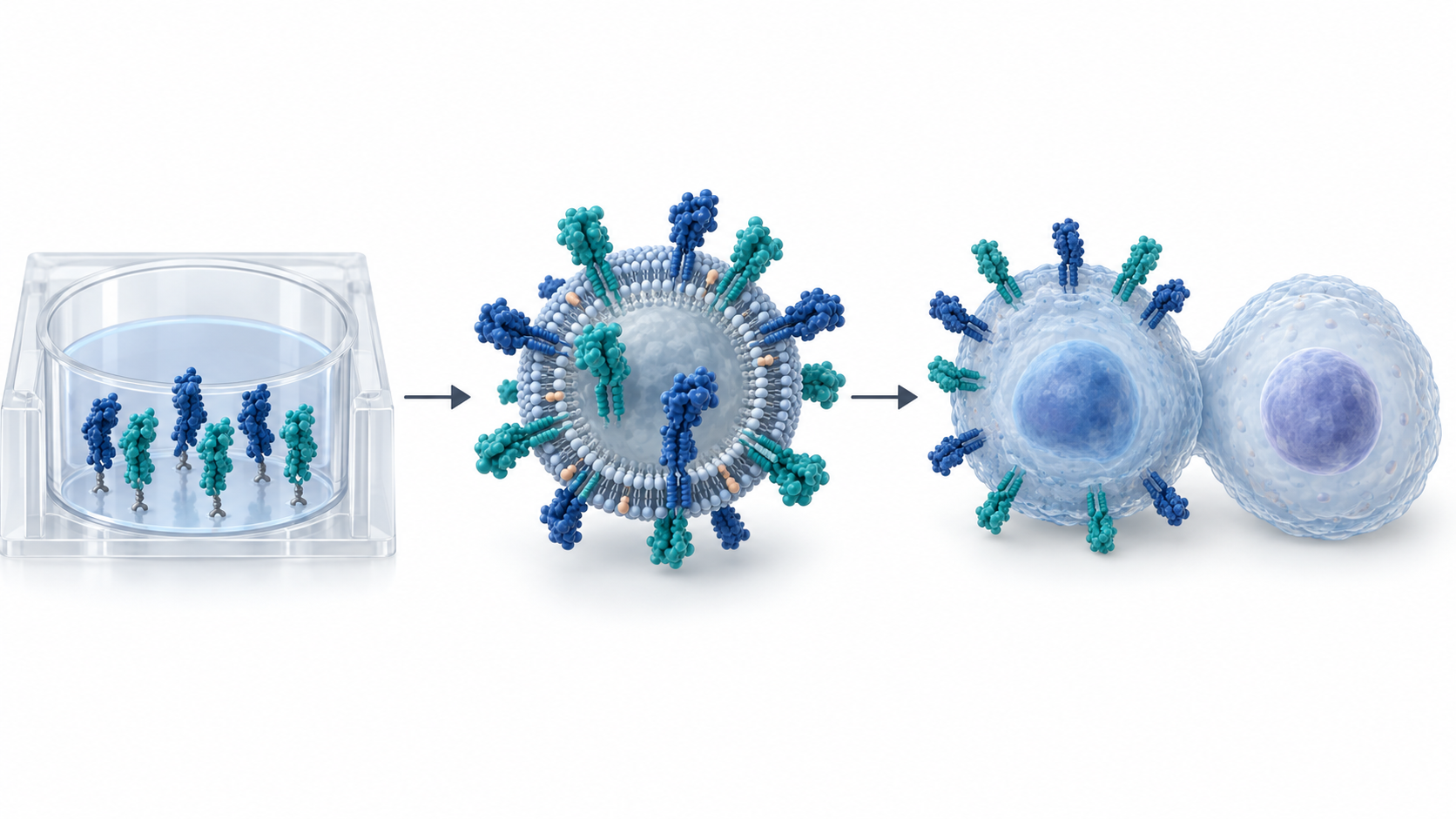
Claudin 18.2 is a membrane-spanning tight-junction protein. Its membrane environment, orientation and accessible extracellular regions can influence whether a signal observed in a plate assay translates to an intact-cell experiment. The useful selection question is therefore: what molecular presentation does this assay need to answer its question?
For research use only. This article provides assay-design guidance, not clinical or diagnostic guidance.
Start with the assay decision
| Question | Suitable starting point | Essential controls |
|---|---|---|
| Does a candidate bind surface-presented target? | Cells expressing full-length Claudin 18.2, with flow cytometry, imaging or another cell-surface readout. | Matched parental or target-negative cells; cell-count or viability check; isotype or irrelevant-binder control where appropriate. |
| Can I rank candidates in a defined biochemical format? | A recombinant preparation whose construct, tag and presentation fit the capture/detection design. | Matrix-only wells; tag-only or format-matched controls; concentration series; confirmation in a cell-based format. |
| Do I need full-length antigen in a membrane context? | A membrane-presented format such as VLP or nanodisc, after verifying construct and product data. | Format-matched negative particle or membrane control where available; background controls; orthogonal confirmation. |
| Do I need a batch record for a transfer decision? | The exact lot documentation and the methods behind its reported specifications. | Datasheet, lot-specific CoA, storage history and predefined acceptance criteria. |
Why presentation matters
Claudin-18 is a claudin-family tight-junction protein with transmembrane topology. A peer-reviewed review describes Claudin 18.2 as a transmembrane component of tight junctions with extracellular loops. That biology is relevant when deciding whether a screen needs cell-surface or another membrane-like presentation.
A soluble or immobilized construct can support a controlled first-pass screen, but a result in that format does not by itself establish binding to target displayed on intact cells. For surface recognition, compare target-positive cells with matched target-negative cells under the same staining, acquisition and gating conditions.
When the study needs full-length antigen in a membrane context, consider a membrane-presented reagent. Biotinylated Human Claudin 18.2 VLP Protein (CLDN182-HB001) is described by PROVETOP as a full-length multi-pass membrane protein in VLP format, expressed in HEK293 cells, for antibody discovery, binding assays and method development. The listed construct is Met1–Val261 and is mapped to UniProt accession P56856-2. Product format remains an experimental variable—not a substitute for orthogonal validation.
A practical selection workflow
1. Define the claim before selecting material
Write one sentence such as “rank candidate binders against a membrane-presented antigen” or “confirm surface binding on cells expressing full-length Claudin 18.2.” It determines whether the next readout should be biochemical, membrane presented or cell based. Do not combine affinity ranking, native-cell recognition and specificity into one unqualified conclusion.
2. Verify target identity and construct details
Check the isoform designation, species, residue range, expression system, tag and stated presentation before ordering. Record those fields with catalog number and lot in the study worksheet. This makes comparisons between VLP, nanodisc and cell-based results interpretable.
3. Pair the first screen with an orthogonal confirmation
For an immobilized assay, document how antigen is captured and test for tag, capture-surface or secondary-reagent signal. For a membrane-presented screen, use a format-matched negative control when available, then move selected hits into a cell-based comparison of target-positive and matched negative cells.
4. Read quality documents as part of assay setup
A Datasheet states what the product is represented to be; a lot-specific CoA documents the released lot and its reported tests. Neither replaces application-specific controls. For CLDN182-HB001, consult the Datasheet for construct and handling information, and use the CoA request route for lot documentation. Confirm the document revision and lot number against the material in hand before reporting values.
Minimum control set
- A target-negative or parental cell control for cell-surface experiments.
- A format- or matrix-matched background control for biochemical or membrane-particle assays.
- A detection-system control separating target signal from tag, capture surface or secondary-reagent signal.
- Technical replicates and a predefined acceptance rule.
- At least one orthogonal follow-up method for candidate-selection decisions.
When to ask for technical support
Ask before ordering if the experiment depends on a particular orientation, tag accessibility, paired negative material, custom format or a required document for a specific lot. Include the assay platform, capture chemistry, species/isoform requirement, detection reagent and planned controls. Contact Technical Support for help comparing formats, requesting lot documentation or discussing an application-specific workflow.
References
- UniProt CLDN18_HUMAN (P56856).
- Chen J, et al. Targeting CLDN18.2 in cancers of the gastrointestinal tract: New drugs and new indications. Frontiers in Oncology. 2023;13:1132319. PMID: 36969060.
Need product documentation or technical support?
Find available product documents, search for a certificate of analysis, or send the technical team your requirement.
Open technical resources