Mouse CD4/LEU3 Protein
Catalog No: CD4-MP001
- Species
- Mouse
- Expression System
- HEK293
- Tag
- His
Product overview
Recombinant Mouse CD4/LEU3 Protein is expressed in HEK293 cells with a His tag at the C-terminus. It contains amino acid residues Lys27-Thr394 (accession: NP_038516.1).
Product Details
- Molecular Aliases
- CD4 antigen (p55); CD4 molecule; CD4 receptor; CD4; CD4mut; EU3
- Protein Length
- Lys27-Thr394
- Expression System
- HEK293
- Theoretical Molecular Weight
- The protein has a predicted MW of 42.4 kDa. Due to glycosylation, the protein migrates to 50-70 kDa based on Bis-Tris PAGE result.
- Purity
- > 95% as determined by Bis-Tris PAGE > 95% as determined by HPLC
- Endotoxin
- Less than 1 EU per μg by the LAL method.
- Buffer / Formulation
- Lyophilized from 0.22μm filtered solution in PBS (pH 7.4). Normally 8% trehalose is added as protectant before lyophilization.
- State
- Lyophilized
- Storage Conditions
- -20 to -80°C for 12 months as supplied from date of receipt. -80°C for 3 months after reconstitution. Recommend to aliquot the protein into smaller quantities for optimal storage. Please minimize freeze-thaw cycles.
- Reconstitution Advice
- Dissolve the lyophilized protein in distilled water. Please refer to the Certificate of Analysis for detailed instructions.
Data Display
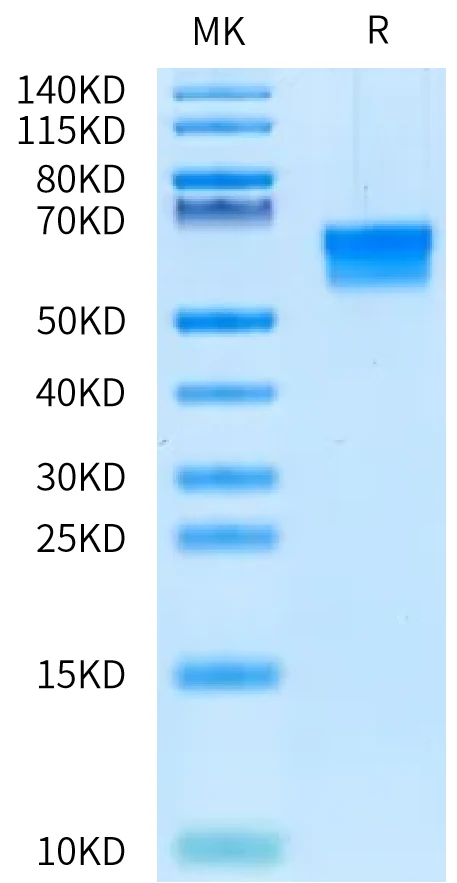
Mouse CD4 on Bis-Tris PAGE under reduced condition. The purity is greater than 95%.
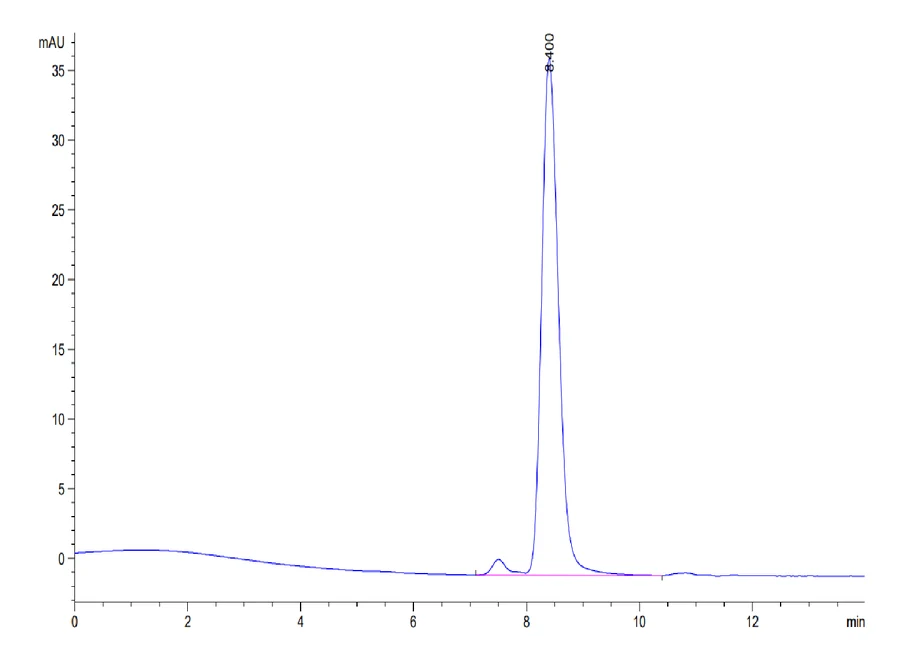
The purity of Mouse CD4 is greater than 95% as determined by SEC-HPLC.
Background
CD4, also known as L3T4, T4, and W3/25, is an approximately 55 kDa type I transmembrane glycoprotein that is expressed predominantly on thymocytes and a subset of mature T lymphocytes. It is a standard phenotype marker for the identification of T cell populations.Integral membrane glycoprotein that plays an essential role in the immune response and serves multiple functions in responses against both external and internal offenses. In T-cells, functions primarily as a coreceptor for MHC class II molecule:peptide complex.
References
- Lam S, Bollard C. T-cell therapies for HIV[J]. Immunotherapy, 2013, 5(4):407-414. Note: HPLC results always come from liquid protein, due to absorption peak interference of trehalose in lyophilized powder.
Have questions about this product?
Our technical team can help with product selection, application questions and order support.