Biotinylated Mouse I-Ab&OVA 323-339 (ISQAVHAAHAEINEAGR) Monomer Protein
Catalog No: OVA-MB001
- Species
- Mouse
- Expression System
- HEK293
- Tag
- His, Avi
Product overview
Recombinant Biotinylated Mouse I-Ab&OVA 323-339 (ISQAVHAAHAEINEAGR) Monomer Protein is expressed in HEK293 cells with a His tag and Avi tag at the C-terminus. It contains amino acid residues Ile27-Glu218 (H2-Aa), Ser30-Lys226 (H2-Ab1) and ISQAVHAAHAEINEAGR peptide (accession: P14434(H2-Aa) & P14483(H2-Ab1) &ISQAVHAAHAEINEAGR).
Product Details
- Molecular Aliases
- I-Ab&OVA 323-339 (ISQAVHAAHAEINEAGR); I-Ab&OVA323-339 (ISQAVHAAHAEINEAGR)
- Protein Length
- Ile27-Glu218
- Expression System
- HEK293
- Theoretical Molecular Weight
- The protein has a predicted MW of 28.5 kDa and 33.1kDa. Due to glycosylation, the protein migrates to 35-40 kDa and 42-50 kDa based on Bis-Tris PAGE result.
- Purity
- > 95% as determined by Bis-Tris PAGE
- Endotoxin
- Less than 1 EU per μg by the LAL method.
- Buffer / Formulation
- Supplied as 0.22 μm filtered solution in PBS (pH 7.4).
- State
- Liquid
- Storage Conditions
- Valid for 12 months from date of receipt when stored at -80°C. Recommend to aliquot the protein into smaller quantities for optimal storage. Please minimize freeze-thaw cycles.
Data Display
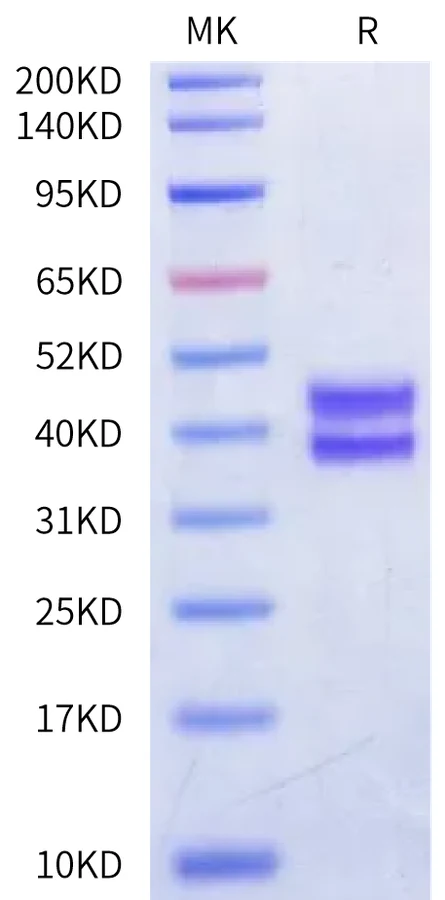
Biotinylated Mouse I-Ab&OVA 323-339 (ISQAVHAAHAEINEAGR) Monomer on Bis-Tris PAGE under reduced condition. The purity is greater than 95%.
Background
OVA 323–339 (ISQAVHAAHAEINEAGR) is a 17–amino acid peptide from chicken Ovalbumin. It is a well-known CD4⁺ T-cell epitope presented by MHC class II molecules to activate helper T cells. This peptide is widely used in mice to study antigen-specific T-cell responses and immune regulation, including models of allergy and autoimmunity. Its defined sequence and reproducible immunogenicity make it a common tool in immunology research.
References
- DO11.10 and OT-II T cells recognize a C-terminal ovalbumin 323-339 epitope. DOI: 10.4049/jimmunol.164.9.4706
- The Serpin-like Loop Insertion of Ovalbumin Increases the Stability and Decreases the OVA 323-339 Epitope Processing Efficiency. DOI: 10.1021/acs.biochem.1c00095
Have questions about this product?
Our technical team can help with product selection, application questions and order support.