Biotinylated Human SLC6A17 Nanodisc
Catalog No: SLC6A17-HB001
- Species
- Human
- Expression System
- HEK293
- Tag
- His
- Activity
- Activity verified
Product overview
Recombinant Biotinylated Human SLC6A17 Nanodisc is expressed in HEK293 cells with a His tag at the C-terminus. It contains amino acid residues Met1-Leu727 (UniProt accession: Q9H1V8).
Product Details
- Molecular Aliases
- NTT4; MRT48
- Protein Length
- Met1-Leu727
- Expression System
- HEK293
- Theoretical Molecular Weight
- The protein has a predicted MW of 94.0 kDa.
- Endotoxin
- Less than 1 EU per μg by the LAL method.
- Buffer / Formulation
- Supplied as 0.22 μm filtered solution in PBS, 200mM L-arginine (pH 7.4). Notice: Not recommended for flow cytometry in mammalian cells.
- State
- Liquid
- Storage Conditions
- Valid for 6 months from date of receipt when stored at -80°C. Recommend to aliquot the protein into smaller quantities for optimal storage. Please minimize freeze-thaw cycles.
Data Display
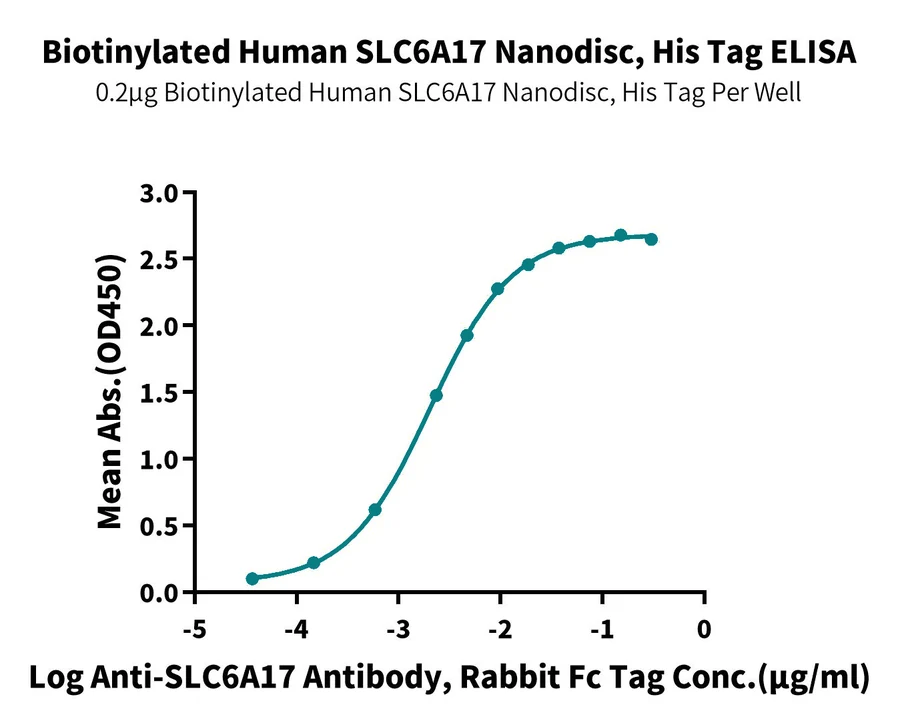
Immobilized Biotinylated Human SLC6A17 Nanodisc, His Tag at 2μg/ml (100μl/well) on the streptavidin precoated plate (5μg/ml). Dose response curve for Anti-SLC6A17 Antibody, Rabbit Fc Tag with the EC50 of 2.0ng/ml determined by ELISA. (QC Test)
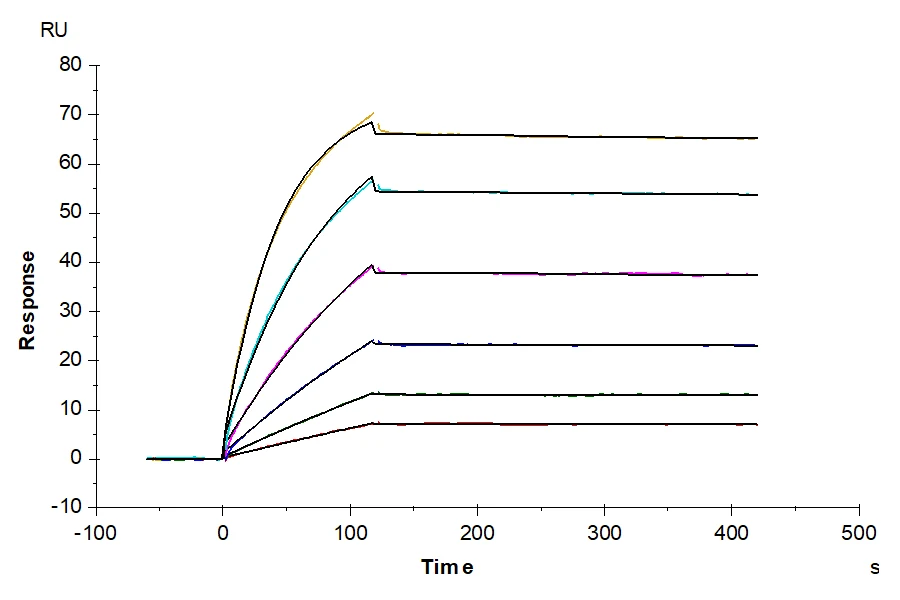
Biotinylated Human SLC6A17 Nanodisc, His Tag captured on CM5 Chip via Streptavidin can bind Anti-SLC6A17 Antibody, Rabbit Fc Tag with an affinity constant of 0.39 nM as determined in SPR assay (Biacore T200).
Background
The vesicular B0AT3 transporter (SLC6A17) one of the members of the SLC6 family, is predominantly expressed in the brain, encodes a synaptic vesicular transporter of neutral amino acids and glutamate, and plays an important role in the regulation of glutamatergic synapses.
References
- Iqbal Z, Willemsen MH, Papon MA, Musante L, Benevento M, Hu H, Venselaar H, Wissink-Lindhout WM, Vulto-van Silfhout AT, Vissers LE, de Brouwer AP, Marouillat S, Wienker TF, Ropers HH, Kahrizi K, Nadif Kasri N, Najmabadi H, Laumonnier F, Kleefstra T, van Bokhoven H. Homozygous SLC6A17 mutations cause autosomal-recessive intellectual disability with progressive tremor, speech impairment, and behavioral problems. Am J Hum Genet. 2015 Mar 5;96(3):386-96. doi: 10.1016/j.ajhg.2015.01.010. Epub 2015 Feb 19. PMID: 25704603; PMCID: PMC4375531.
Have questions about this product?
Our technical team can help with product selection, application questions and order support.