Biotinylated Human APOE3/Apolipoprotein E Protein
Catalog No: APOE3-HB001
- Species
- Human
- Expression System
- HEK293
- Tag
- His, Avi
Product overview
Recombinant Biotinylated Human APOE3/Apolipoprotein E Protein is expressed in HEK293 cells with a His tag and Avi tag at the C-terminus. It contains amino acid residues Lys19-His317 (UniProt accession: P02649-1).
Product Details
- Molecular Aliases
- Apolipoprotein E; Apo-E; APOE; apolipo E; APOE3
- Protein Length
- Lys19-His317
- Expression System
- HEK293
- Theoretical Molecular Weight
- The protein has a predicted MW of 37.66 kDa. Due to glycosylation, the protein migrates to 35-45 kDa based on Bis-Tris PAGE result.
- Purity
- > 95% as determined by Bis-Tris PAGE
- Endotoxin
- Less than 1 EU per μg by the LAL method.
- Buffer / Formulation
- Supplied as 0.22 μm filtered solution in PBS, 200mM L-arginine (pH 7.4).
- State
- Liquid
- Storage Conditions
- Valid for 12 months from date of receipt when stored at -80°C. Recommend to aliquot the protein into smaller quantities for optimal storage. Please minimize freeze-thaw cycles.
Data Display
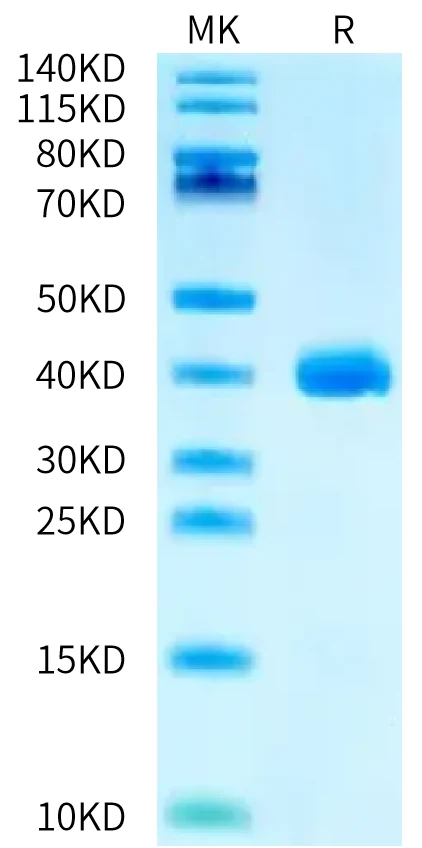
Biotinylated Human APOE3 on Bis-Tris PAGE under reduced condition. The purity is greater than 95%.
Background
Apolipoprotein E (apoE) is a lipid carrier in both the peripheral and the central nervous systems. Lipid-loaded apoE lipoprotein particles bind to several cell surface receptors to support membrane homeostasis and injury repair in the brain. Considering prevalence and relative risk magnitude, the ε4 allele of the APOE gene is the strongest genetic risk factor for late-onset Alzheimer's disease (AD).
References
- Zhao N, Liu CC, Qiao W, Bu G. Apolipoprotein E, Receptors, and Modulation of Alzheimer's Disease. Biol Psychiatry. 2018 Feb 15;83(4):347-357. doi: 10.1016/j.biopsych.2017.03.003. Epub 2017 Mar
- PMID: 28434655; PMCID: PMC5599322.
Have questions about this product?
Our technical team can help with product selection, application questions and order support.