Biotinylated Cynomolgus/Rhesus macaque LRRC15/LIB Protein
Catalog No: LRRC15-CB001
- Species
- Cyno/Rhesus
- Expression System
- HEK293
- Tag
- His, Avi
- Activity
- Activity verified
Product overview
Recombinant Biotinylated Cynomolgus/Rhesus macaque LRRC15/LIB Protein is expressed in HEK293 cells with a His tag and Avi tag at the C-terminus. It contains amino acid residues Tyr22-Gly538 (accession: A0A2K5UKB6(Cynomolgus) / F7FSB9(Rhesus macaque)).
Product Details
- Molecular Aliases
- LIB; LRRC15; EGM_11224
- Protein Length
- Tyr22-Gly538
- Expression System
- HEK293
- Theoretical Molecular Weight
- The protein has a predicted MW of 61.50 kDa. Due to glycosylation, the protein migrates to 70-90 kDa based on Bis-Tris PAGE result.
- Purity
- > 95% as determined by Bis-Tris PAGE > 95% as determined by HPLC
- Endotoxin
- Less than 1 EU per μg by the LAL method.
- Buffer / Formulation
- Lyophilized from 0.22 μm filtered solution in PBS (pH 7.4). Normally 8% trehalose is added as protectant before lyophilization.
- State
- Lyophilized
- Storage Conditions
- -20 to -80°C for 12 months as supplied from date of receipt. -80°C for 3 months after reconstitution. Recommend to aliquot the protein into smaller quantities for optimal storage. Please minimize freeze-thaw cycles.
- Reconstitution Advice
- Dissolve the lyophilized protein in distilled water. Please refer to the Certificate of Analysis for detailed instructions.
Data Display
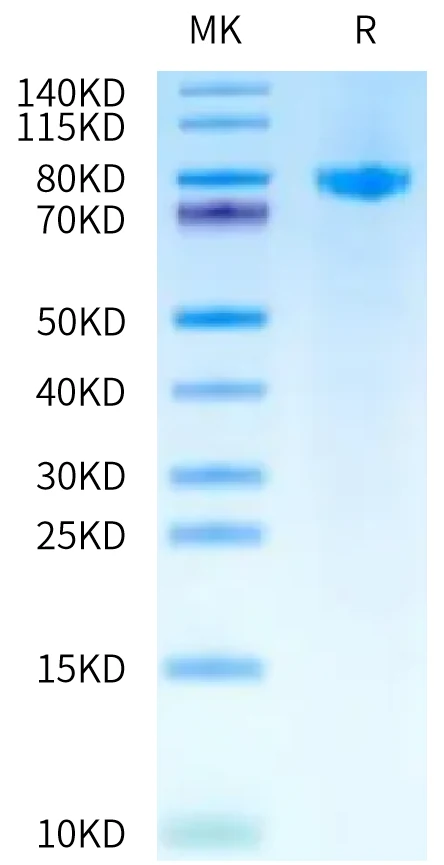
Biotinylated Cynomolgus/Rhesus macaque LRRC15 on Bis-Tris PAGE under reduced condition. The purity is greater than 95%.
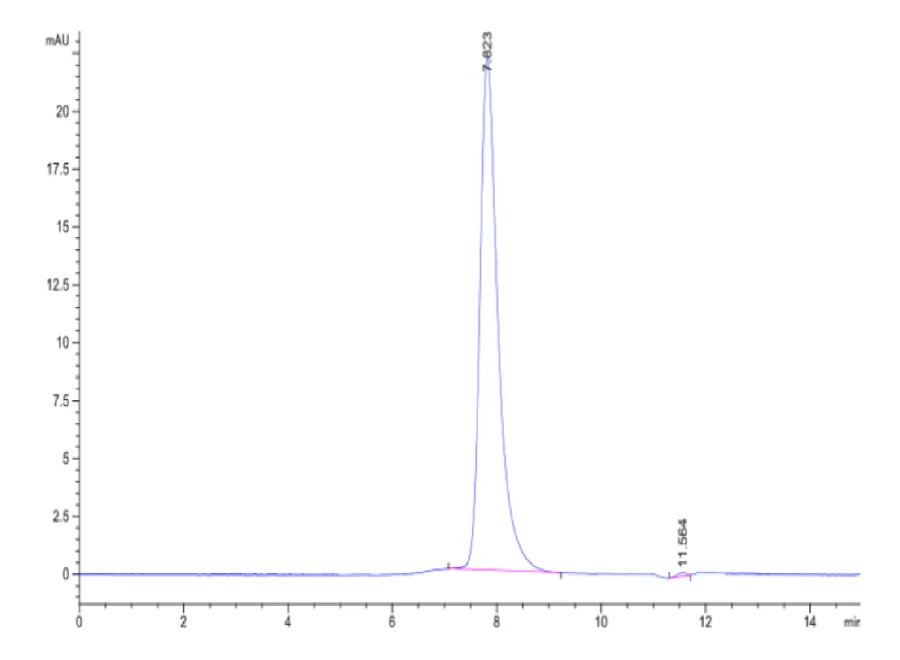
The purity of Biotinylated Cynomolgus/Rhesus macaque LRRC15 is greater than 95% as determined by SEC-HPLC.
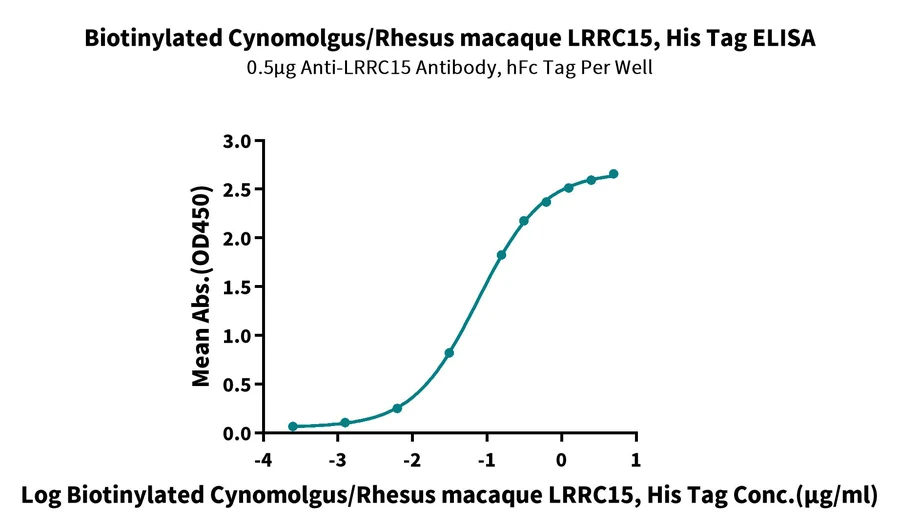
Immobilized Anti-LRRC15 Antibody, hFc Tag at 5μg/ml (100μl/well) on the plate. Dose response curve for Biotinylated Cynomolgus/Rhesus macaque LRRC15, His Tag with the EC50 of 75.9ng/ml determined by ELISA.
Background
The leucine-rich repeat-containing protein 15 (LRRC15) is involved in cell–cell and cell–matrix interactions and came into focus as a promising anticancer target owing to its overexpression in mesenchymal-derived tumors such as sarcoma, glioblastoma, and melanoma and in cancer-associated fibroblasts in the microenvironment of breast, head and neck, lung, and pancreatic tumors.
References
- Ray U, Pathoulas CL, Thirusangu P, Purcell JW, Kannan N, Shridhar V. Exploiting LRRC15 as a Novel Therapeutic Target in Cancer. Cancer Res. 2022 May 3;82(9):1675-1681. doi: 10.1158/0008-5472. CAN-21-3734. PMID: 35260879; PMCID: PMC9064950.
Have questions about this product?
Our technical team can help with product selection, application questions and order support.