Biotinylated Human CXCR5 Nanodisc
Catalog No: CXCR5-HB002
- Species
- Human
- Expression System
- HEK293
- Tag
- His
- Activity
- Activity verified
Product overview
Recombinant Biotinylated Human CXCR5 Nanodisc is expressed in HEK293 cells with a His tag at the C-terminus. It contains amino acid residues Met1-Phe372 (UniProt accession: P32302-1).
Product Details
- Molecular Aliases
- CXC-R5; CXCR-5; MDR-15; MDR15; CD185; BLR1; CXCR5
- Protein Length
- Met1-Phe372
- Expression System
- HEK293
- Theoretical Molecular Weight
- The protein has a predicted MW of 54.9 kDa.
- Endotoxin
- Less than 1 EU per μg by the LAL method.
- Buffer / Formulation
- Supplied as 0.22 μm filtered solution in PBS, 200mM L-arginine (pH 7.4). Notice: Not recommended for flow cytometry in mammalian cells.
- State
- Liquid
- Storage Conditions
- Valid for 6 months from date of receipt when stored at -80°C. Recommend to aliquot the protein into smaller quantities for optimal storage. Please minimize freeze-thaw cycles.
Data Display
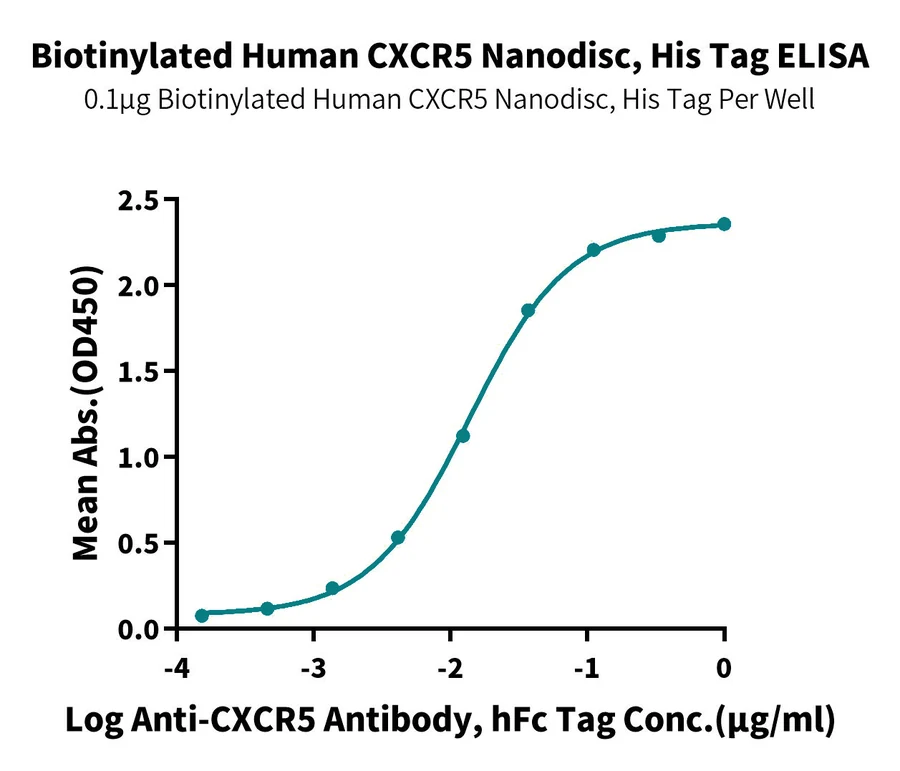
Immobilized Biotinylated Human CXCR5 Nanodisc, His Tag at 1μg/ml (100μl/well) on the streptavidin precoated plate (5μg/ml). Dose response curve for Anti-CXCR5 Antibody, hFc Tag with the EC50 of 13.7ng/ml determined by ELISA. (QC Test)
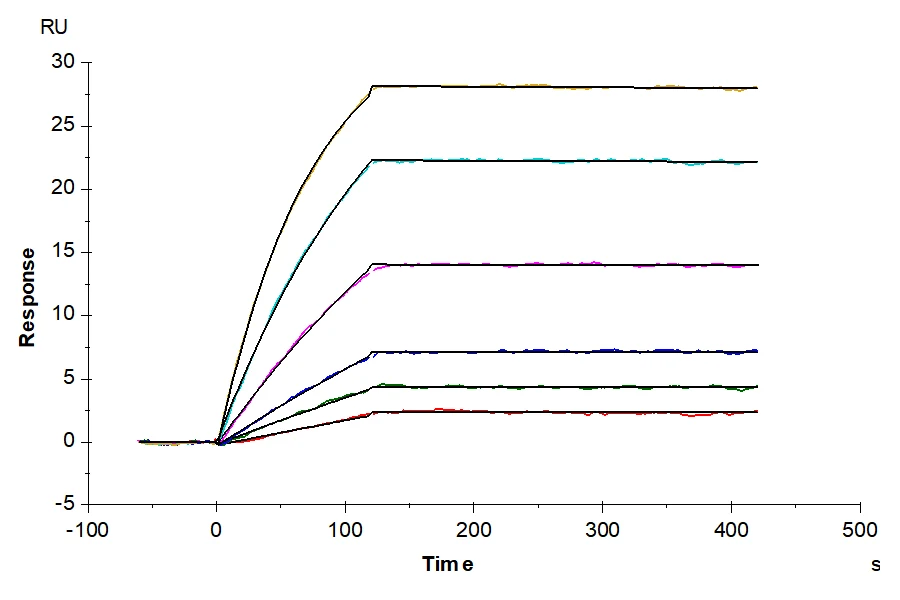
Biotinylated Human CXCR5 Nanodisc, His Tag captured on CM5 Chip via Streptavidin can bind Anti-CXCR5 Antibody, hFc Tag with an affinity constant of 15.36 pM as determined in SPR assay (Biacore T200).
Background
CXCR5 is a serpentine receptor implicated in cell migration in lymphocytes and differentiation in leukocytes. It causes MAPK pathway activation and has known membrane partners for signaling. CXCR5 is also expressed in HL-60 cells, a human acute myeloid leukemia line, following treatment with all-trans retinoic acid, which induces differentiation toward a neutrophil-like state. CXCR5 is necessary for this process; differentiation was crippled in CXCR5 knockout cells and enhanced in cells ectopically expressing it.
References
- MacDonald RJ, Yen A. CXCR5 overexpression in HL-60 cells enhances chemotaxis toward CXCL13 without anticipated interaction partners or enhanced MAPK signaling. In Vitro Cell Dev Biol Anim. 2018 Dec;54(10):725-735. doi: 10.1007/s11626-018-0293-z. Epub 2018 Oct 1. Erratum in: In Vitro Cell Dev Biol Anim. 2020 Oct;56(9):825. doi: 10.1007/s11626-020-00510-0. PMID: 30276608; PMCID: PMC6657802.
Have questions about this product?
Our technical team can help with product selection, application questions and order support.