Human CD3D/CD3 delta Protein
Catalog No: CD3D-HP001
- Species
- Human
- Expression System
- HEK293
- Tag
- His
Product overview
Recombinant Human CD3D/CD3 delta Protein is expressed in HEK293 cells with a His tag at the C-terminus. It contains amino acid residues Phe22-Ala105 (UniProt accession: P04234-1).
Product Details
- Molecular Aliases
- CD3d; CD3D; CD3-DELTA; T3D; CD3 delta; T3DOKT3; CD3-DELTA; IMD19
- Protein Length
- Phe22-Ala105
- Expression System
- HEK293
- Theoretical Molecular Weight
- The protein has a predicted MW of 10.4 kDa. Due to glycosylation, the protein migrates to 17-30 kDa based on Bis-Tris PAGE result.
- Purity
- > 95% as determined by Bis-Tris PAGE > 95% as determined by HPLC
- Endotoxin
- Less than 1 EU per μg by the LAL method.
- Buffer / Formulation
- Lyophilized from 0.22μm filtered solution in PBS (pH 7.4). Normally 8% trehalose is added as protectant before lyophilization.
- State
- Lyophilized
- Storage Conditions
- -20 to -80°C for 12 months as supplied from date of receipt. -80°C for 3 months after reconstitution. Recommend to aliquot the protein into smaller quantities for optimal storage. Please minimize freeze-thaw cycles.
- Reconstitution Advice
- Dissolve the lyophilized protein in distilled water. Please refer to the Certificate of Analysis for detailed instructions.
Data Display
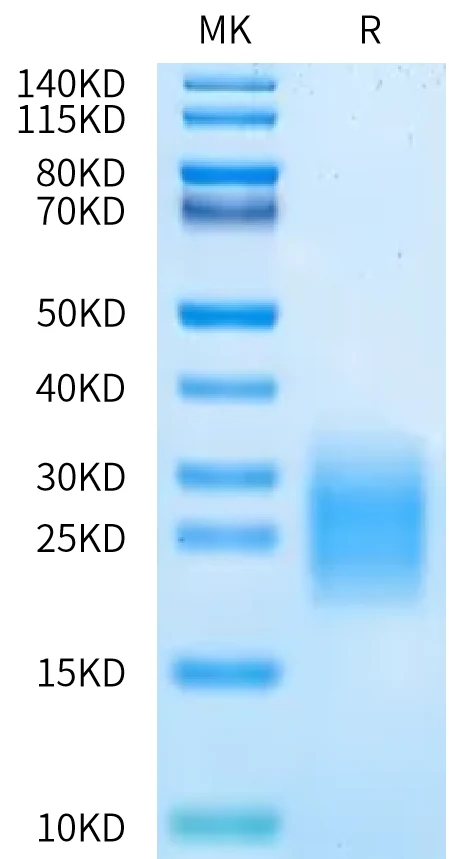
Human CD3 delta on Bis-Tris PAGE under reduced condition. The purity is greater than 95%.
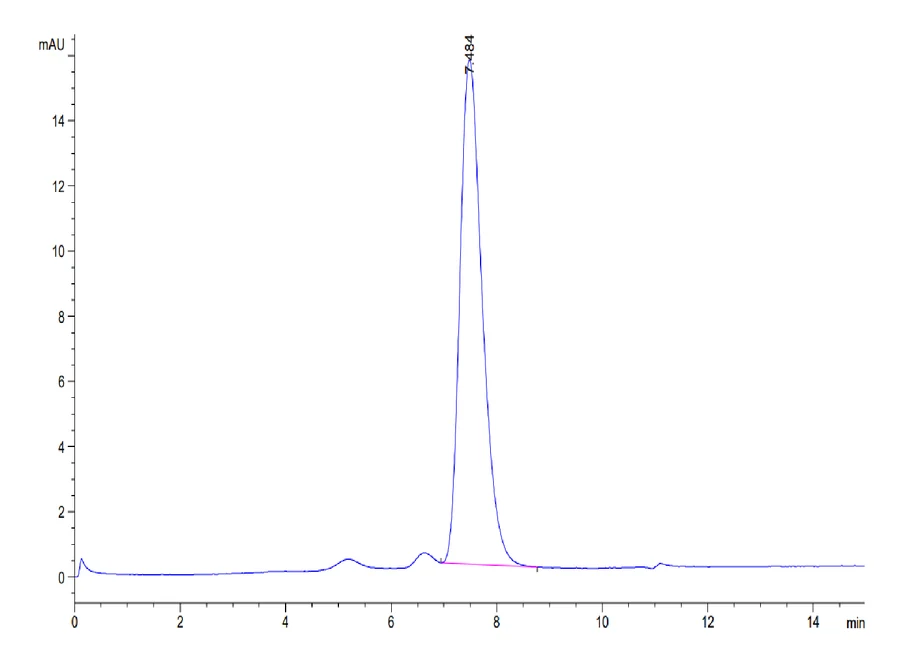
The purity of Human CD3 delta is greater than 95% as determined by SEC-HPLC.
Background
T-cell surface glycoprotein CD3 delta chain, also known as CD3D, is a single-pass type I membrane protein.In immunology, the CD3 (cluster of differentiation 3) T cell co-receptor helps to activate both the cytotoxic T cell (CD8 naive T cells) and also T helper cells (CD4 naive T cells). It consists of a protein complex and is composed of four distinct chains. In mammals, the complex contains a CD3γ chain, a CD3δ chain, and two CD3ε chains.
References
- Penaranda C, Tang Q, Bluestone J A. Anti-CD3 Therapy Promotes Tolerance by Selectively Depleting Pathogenic Cells while Preserving Regulatory T Cells[J]. The Journal of Immunology, 2011, 187(4):2015-2022.
Have questions about this product?
Our technical team can help with product selection, application questions and order support.